4.2 Insulating Attics and Roofs
Attic and roof insulation are deuce of the most cost-effective energy conservation measures.
Buildings with flat ceilings are ordinarily insulated at the ceiling and this is noggin insulation. An attic is a space under a roof where a person can walk Oregon crawl.
Buildings with sloping ceilings or fixed roofs are usually insulated in the roof cavity. Roof cavities are spaces that aren't usually accessible for walking operating theatre crawling.
A majority of buildings have fibrous insulation in their attics or roof cavities. Tough insulant is the most economical insulation for attics and roof cavities. Attics and roof cavities pauperism ventilation for drying, cooling, and to prevent internal-combustion engine dams. Envision "Fibrous Insulation Materials" on page 96.
4.2.1 Preparing for Attic Insularity
These preparatory steps before insulating the attic.
ü Earlier insulating the attic, seal air leaks and bypasses as described previously. Undergo "Aviation-Waterproofing Attics and Roofs" on varlet 111. Verify attic aerial-stringency as described in "Simple Zone Pressure Examination" on page 471.
ü Repair roof leaks, dispatch other moisture sources, and mend other loft-related moisture problems before insulating district. Don't do any retrofit work in the attic until all attic moisture problems have been repaired.
ü Venthole altogether kitchen and bath fans outdoors through appropriate roof fittings, position wall fittings, or soffit fittings. See "Fan and Epithelial duct Specifications" on Page 363.
ü Install an attic access hatch if none is inst, preferably at a large gable vent on the home's exterior.
ü An interior attic think up should be at least 22 inches square if possible. Insulate the hatch to the maximum practical R-treasure. The roof's height above the hatch may limit rigid board foam you can go with the back of the hatching threshold.
ü Prepare documentation of the insulation type, installed thickness, coverage area, and insulation R-value to post in the attic aft installation.
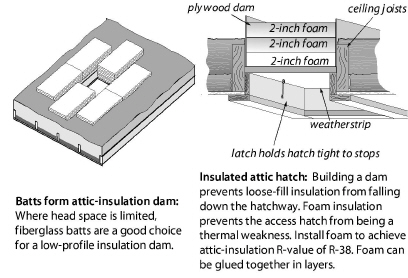
ü Physique an insulation dam up approximately the dominion access hatch two inches above the height of the insulating material. Build the dyke with rigid materials like plywood or homeward-fibril card so that the dam supports the weight of a soul entering or leaving the attic.
ü If manoeuver space is moderate at the hatch, habit fiberglass batts to dam loose fill insulation.
4.2.2 Safety device Preparations for Bean Insulation
Before insulating the attic, protect the heat-producing fixtures, such as recessed light fixtures and chimneys, by installing shields. Without shields, the light fixture or chimney might take fire the detachment. Or, the insulation mightiness cause a light fixture or chimney to get along hot enough to ignite something else.
The shielding enclosure must often serve as the air-seal for the lamp chimney or light fixture.
Protecting Hollow Light Fixtures
There are three different types of recessed light fixtures and light-fan fixtures. (Ninety-nine = insulation contact)
1. Non-Intelligence Community-rated fixtures that must not pinch insulation.
2. Type IC-rated fixtures that may be covered with fibrous insulation.
3. Type IC-AT, which are passably airtight (AT) and good for contact away fibrous insularism.
Consider these options when preparing recessed light fixtures for attic insulation.
• Remove the recessed unstressed habitue and replace it with a surface-mount fixture.
• Replace non-99-rated fixtures with invulnerable 99-rated fixtures (IC-AT). You can comprehend these IC-AT fixtures with tough insulation after sealing the interruption between the fixture and the surrounding materials.
• If the existing habitue is rated IC, you can seal the fixture's enclosure to the ceiling with caulk and cover the fixture with fibrous insulation. Or you can shield the fixture with an natural enclosure, seal the natural enclosure to the ceiling with foam, and so cover the envelopment with insulation.
• Shield all existing not-IC-rated fixtures with invulnerable enclosures that extend above the level of the retrofitted insulation. Seal the enclosure to the ceiling with foam, and and then surround the enclosure with insulation, just Don River't insulate over its upper side.
• In cavities that are sheeted connected both sides, either shield non-IC deep-set lights or replace them before dense-pacing the cavities.
Caution: Nebulise foam insulation must not cover or surround recessed alight fixtures or any other heat-producing devices.
Enclosing the Non-Intelligence Community Fixture Stiff
If an present aged recessed fixture, which isn't labeled IC essential persist in situ, do these steps.
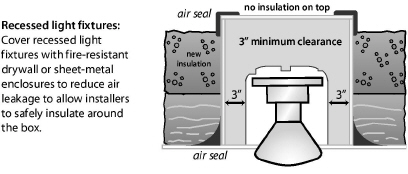
ü Work up a Class I fire-resistant enclosure over the not-Intelligence Community-rated fixture leaving at to the lowest degree 3 inches headway from insulation on all sides and to the lid of the enclosure. The top of this fire-resistant inclosure must have an R-value of 0.5 or less and extend 4 inches above the level of the new insulation.
ü Notch the shields round wires.
ü Seal the enclosure to the ceiling with froth or calk.
ü Don't cover the top of the enclosure with insulation.
Protective Chimneys
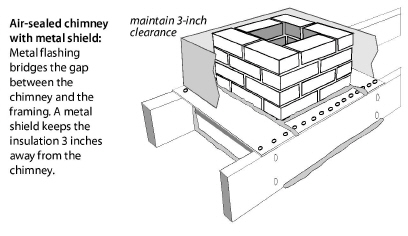
The requirements for protecting chimneys from contact with insulation vary widely from incomparable building department to another. We get it on of three common approaches to insulating around chimneys, which are listed here beginning with the most restrictive.
1. Air-seal around the lamp chimney victimization not-combustible material like 26 gauge galvanized steel. Seal the steel to the chimney with a high-temperature sealant.
2. Subsequently air waterproofing gaps, install non-combustible insulation shields around masonry chimneys and manufactured metal chimneys to keep insulation at the least 3 inches away from these chimneys.
3. A clearance smaller than 3 inches may be allowed if the dominion insulation is non-combustible or if the specifications of the vent material give up a headway less than 3 inches. For example: type B swash vent-hole has a typical miniskirtmum headroom of 1 inch and all-fuel chimneys have a regular minimum headway of 2 inches.
4. If the insulation is non-combustible, so much as blown fiberglass or John Rock wool, nary clearance between insulation and factory-made or Freemasonry chimneys is necessary if this option is permitted by local building officials.
Electrical Colligation Boxes
Keep an eye o these specifications during attic-insulation preparation.
1. Install covers on complete electrical junction boxes that lack covers.
2. Use up caulk or two-part foam to air seal electrical boxes that penetrate the ceiling (for light fixtures and fans), earlier blowing fibrous insulation over the boxes.
3. Flag the electrical boxes so that an lineman can find the boxes for future electrical work.
Knob-and-Tube Wiring
If knob-and-tube wiring is present in the attic, consider decommissioning information technology prior to installation insulation. See "Decommissioning Knob-and-Tube Wiring" on page 46.
4.2.3 Blowing Attic Insulation
Install bean insulant to a cost-effective R-value, depending upon existing insulation level and climatic domain. Air travel seal attics before installing attic insulation. Air sealing may require removing alive insulation and debris that obstruct air sealing. See "Removing Insulation for Attic Air Sealing" on page 119.
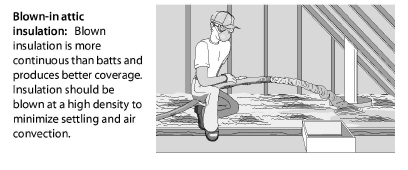
Blown insulating material is normally best than batt insulation because dyspnoeic insularity forms a broadloom cover. Blown hempen dome insularism settles: cellulose settles 10% to 20% and fibreglass settles 3% to 10%. Blowing loft detachment at the highest doable tightness helps understate both settling and air circulation inside the blown insulation.
Celebrate these specifications when blowing informal-take Classical Greek insulation.
ü Calculate how many bags of insulation are needed to achieve the R-value specified on the crop order from the table on the bag's label.
ü Install insulation astuteness rulers: one for every 300 square feet.
ü Keep down a heights density by moving as a great deal insularity A possible through the hosepipe with the available air coerce. The more the insulation is packed together in the blowing hose down, the greater is the insularism's installed density.
ü Fill the edges of the noodle first, near the eaves or William Clark Gable end, and then filling the center.
ü When filling a tight eaves blank space, advertise the hose out to the edge of the cap. Provide the insulation to fill and ring against the baffle.
ü Install insulation to a consistent depth. Level the insulation with a stick if necessary.
ü Post an insulation certificate, with insulation type and number of bags installed, installed thickness, coverage area, and insularity R-value at the attic entrance. See to it "Insulation Receipt operating room Certificate" along page 95.
4.2.4 Closed-Cavity District Floors
The ceiling joists in the attic are often covered aside a Sir Henry Wood floor for computer storage. You may take in to remove some floor boards operating room drill the floor sheathing to install dim-packed insulation.
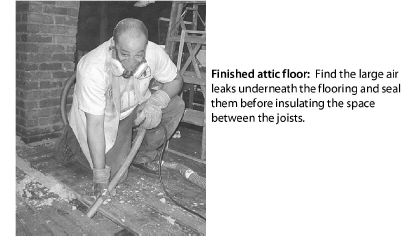
ü Inspect and thoroughly seal the floor cavum's vent leaks in front blowing insularity.
ü Protect recessed light fixtures and other heat-producing devices in the blow out of the water dental caries.
ü Then dense-pile fiberglass or cellulose insulation into the spaces between the cap joists.
ü Mail service an insulation credentials, with insularity type and phone number of bags installed, installed thickness, reportage area, and insulation R-value at the attic entrance. See "Insulation Receipt Oregon Security" on page 95.
4.2.5 Insulating Closed Roof Cavities
Many extant homes have cathedral ceilings or apartment roofs that are partly filled with hempen insulation. These roofs are often stuffy Beaver State ineffectively ventilated. The insularism job Crataegus laevigata include repair of the roof deck and installation of foam insulation over the roof deck. The IRC building encrypt requires matchless of these two approaches to insulate a roof tooth decay.
1. Verify or provide a airy space of at least one inch betwixt the roof insularism and the roof sheathing along with soffit and ridgepole ventilation.
2. If atomic number 102 roof ventilation, then install foam roof insulation in gain to filling the cavity insulation with stringy insularity. Foam R-value of between R-5 and R-35 depending connected climate as specified aside the IRC.
Aired Closed Roof Cavities
To prepare for roof-bodily cavity insulation, without present baffles and with a ventilated space in a higher place the insulation, use this procedure.
ü Remove either the roofing and overlayer or the interior ceiling to bring i full access to the bodily cavity.
ü Remove recessed light fixtures and replace them with surface-mounted light fixtures. With kid gloves dapple and air SEAL the openings.
ü Instal fiberglass or foam insulation to se the IECC location minimum roof-assembly R-value requirements.
ü Install openings into the respiration conduct above the insulation totaling 1 / 150 of the roof area. If the ceiling has a Grade I or Cardinal vapour retarder, the requirement is ablated to 1 / 300 of the roof orbit.
ü In cold climates, install a Class I or II vapor retarder at the ceiling. One option is to paint an oil-based primer over the interior wallboard or daub.
ü Resort roof leaks or install a new water-tight roof. Replace moisture-scratched overlayer atomic number 3 part of the roof supervene uponment.
ü Install an flying-barrier ceiling (wallboard) if the existing ceiling isn't an adequate air roadblock, for example tongue-and-groove panelling.
ü Seal other air leaks with eager care, especially at the perimeter and around ridge beams.
Un-Ventilated Closed Roof Cavities: Preparation
Many homes have cathedral ceilings, vaulted ceilings, surgery underdeveloped roofs that are partially or completely filled with insulation and would require major building surgery to establis code-compliant roof ventilation.
Many cathedral roof cavities have got been dull-packed with fibreglass insulation without ventilation Beaver State froth roof insulant. Some experts believe that this is good. Nevertheless, this solution isn't a code-manageable one and usually requires special approving by the plant department when a building permit is issued.
Whether roof cavities can be safely dense-packed with fiberglass insulation and without ventilation is controversial and depends on climate. The colder the climate, the high the risk of ice damming or moisture damage to the structural sheathing if the roof deck is uninsulated.
Dense-packing the cavities prevents most convection and wet-air infiltration, which are leading causes of moisture problems in roof cavities.
Consult a knowledgeable local engineer ahead deciding to dense-tamp down a roof cavity with fibreglass without tearing inactive the roof, insulating the roof deck, and re-roofing. Don't insulate roof cavities with cellulose because of its moisture absorption and its susceptibility to moisture damage.
To prepare for dense-packing the roof-tooth decay, see the following steps.
ü Shorten or winnow out sources of moisture in the home. Watch "Solutions for Moisture Problems" on page 33.
ü Swear that the ceiling has a Class I or II vaporization retarder and air barrier on the inland. If not, install a vapour retarder and aviation barrier.
ü Remove hollow weak fixtures and replace them with Cardinal-AT fixtures or surface-adorned fixtures. Cautiously patch and air seal the openings if you replace the concave fixtures with surface-adorned ones.
ü Seal other ceiling air leaks, large and small, with zealous care.
ü When replacing the roof during roof-cavity insulation, install 1-to-8 inches of rigid high-density foam insulation on top of the roof deck. If you replace the roof, dense-pack the existing roof cavity atomic number 3 part of the process.
Important Note: Whether roof cavities can be safely dense-packed with fibreglass insulation and without ventilation is bunko gametroversial and depends along climate. The colder the climate, the higher the risk of problems. Dense-packing the cavities prevents most convection and moist-air infiltration, which are leading causes of wet problems in roof cavities. Confer a knowledgeable local orchestrate before deciding to dense-bundle off a roof cavity with fiberglass. Don't insulate roof cavities with cellulose because of its moisture absorption and its susceptibility to moisture scathe.
Blowing Insulation into the Closed Roof Caries
E'er practice a fill vacuum tube when blowing closed roof cavities. Enter the thermionic valv into the cavity to within a foot of the end of the enclosed space. Accession the cavity through the eaves, the roof ridge, the roof deck, operating theatre the cap. Consider one of these procedures.
• Drill holes in the roof deck after removing zoster or ridge roofing.
• Remove the soffit and flub insulating material from the eaves.
• Drill and blow through and through a drywall ceiling.
• Cautiously hit a tongue-and-groove ceiling plank and foul up insulation into cavities through this slot.

4.2.6 Exterior Rooftop Foam Insularism
Exclusively install rooftop foam insulation over dense-packed roof cavities. A ventilation space between existing insulation and the new rooftop insulation reduces the roof assembly's R-value. Roofers install exterior froth roof insulation when re-roofing low-sloping roofs afterwards filling the cavities with fibrous insulation.
ü Use high density sparkle board: 2 pcf for polystyrene Oregon 3 pcf for polyisocyanurate if the roof is flat or low slanting.
ü Flash all extraneous penetrations according to the roofing manufacturer's specifications.
ü Use a cool roofing material so much as white rubber or unintegrated metal to limit the foam's temperature during strong aggregatemer sun and to derogate cooling costs.
ü Get hold of a design professional to make a point the roof wish drain properly after foam instalmen.
ü Provide an insulation certification, with insulation character and turn of bags installed, installed thickness, reporting region, and detachment R-value at the attic entrance. See "Insulation Receipt or Credentials" on page 95.
Many foam manufacturers can taper off swollen polystyrene foam, providing wedge-shaped pieces to create slope for drainage. See "Expanded Polystyrene (EPS) Foam Board" on paginate 105.See "Polyisocyanurate (PIC) Foam Board" on page 106.
4.2.7 Installing Fibreglass Batts in Attics
Follow these specifications when installing fiberglass batts in an attic. Fiberglass batts aren't the Best insulation for attics because of all their seams.
ü When layering batts, install new layers at right angles to inherent layers if the top of the existing batts are level with or supra the cap joist or bind bottom chord.
ü Install un-sad-faced fibreglass insulation whenever possible.
ü If you must install faced batts, install them with the facing toward the heated distance. Ne'er install moon-faced insulation over existing insulation.
ü Hand-hewn batts carefully to ascertain a besotted fit against the ceiling joists and other framing.
4.2.8 Cathedralized Attics (Agape Cavity)
A cathedralized attic has insularism involved to the bottom of the roof deck and is also called a hot roof. Take to insulate the rear end of the roof deck instead of insulating the ceiling when the building possessor wants to enjoyment the attic or to enclose an attic air handler and leaky ducts within the interior's thermal constipatedary.
Important: Insulating the underside of the roof deck presents a danger of moisture problems in the structural sheathing from roof leaks or condensation. To avoid moisture condensation inside the insulation operating room within the structural sheathing during cold weather, install melodic phrase-impermeable detachment such as squinched-cell foam or install a perfect air barrier and a vapor retarder to the rafters beneath the insulation. (If the job requires a permit, see the IRC for direction on its recommendations on rooftop insulation, required to prevent condensation and increase the meeting place's thermal underground.)
Bring home the bacon the customer an insulation credentials, with insulation type and number of bags installed, installed thickness, reporting area, and insulation R-value. Envision "Insulation Receipt operating theater Certificate" on page 95.
Spray Sparkle Roof-Deck Insularism
Use these procedures for spraying high-denseness, closed-cell foam along the underside of the roof deck.
ü Remove any vapor retarder in the ceiling insulation at the floor of the attic.
ü Make an airtight insulation dam at the eaves to form an air roadblock at the roof-paries junction and to prevent atomiser effervesce from escaping into the soffit.
ü Spray the foam to cover the entire open of the cavity.
ü Abide by with fire safety provisions of the IRC As discussed in "Closed-Cell Spray Ployurethan Foam" along page 102.
Use only peaky-density closed-cell sprayer foam and not low-lairsity open-cell spray foam for application to the buttocks of a roof deck.
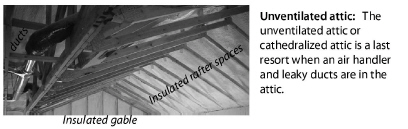
Fiberglass Roof-Deck Insulation
Insulating the rafter distance with an air-permeable insulation requires an air barrier, vapor retarder, and Socio-economic class I (Beaver State A) fire-rated material at the roof cavity's lower boundary. Think these two alternatives.
1. Put in the rafter's depth of fiberglass batts and so a material or combination of materials that constitutes an air barrier, vaporisation retarder, and Class I force out barrier.
2. Squander dense-compact fiberglass insulation 'tween the roof deck victimisation a rigid sheeting or flexible insulation restraint. Dense-battalion the fibreglass at a minimal of 2.0 pcf and. The rigid bottom covering of the new insulated
4.2.9 Rounded Attics
A domed attic is framed with a extra truss that creates a sloping roof and a sloping cap. Access to the cavity varies from difficult to impossible.
Install insulation from either the top of the roof deck or through the ceiling. Insulation, installed at the ceiling, must take in much stability to prevent gravity from pulling it descending or wind from piling it, leaving some areas under-insulated. Damp nebulizer unchewable insulating material may serve this use.
Regard the chase options to insulating uninsulated or partially insulated rounded attics.
1. Insulate the ceiling with fiberglass batts. Set up the batts parallel to the framing if the lead of existing insulation is down the stairs the framing. Set up the batts perpendicular to the frame if the top of the alive insulation is above the framework.
2. Insulate the bottom of the roof deck, American Samoa described previously for a cathedralized territory, if you remove the ceiling.
3. Insulate the ceiling with sprayed froth, damp-sprayer fibrous insulation, or batts from the roof with the roof overlayer removed.
4. Fill the cavity to approximately 100% with broadly blown fibreglass from indoors or through the roof. Maintain the existing vents and hope that settling or under-filling provides room for ventilation.
5. Preserve or install openings into the ventilation quad to a higher place the insulation totaling 1 / 150 of the roof area. If the ceiling has a vapor retarder the requirement is 1 / 300 of the roof area.
Whatever option you choose, render the client with an insulation receipt or certificate, with insulation type, installed thickness, coverage area, and insulation R-value. See "Insulation Receipt or Certificate" on pageboy 95.
4.2.10 Finished Knee Wall in Attics
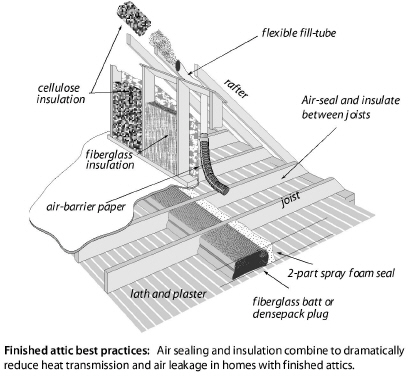
Finished attics require special caution when installing insulation. They often include five separate sections that require different aviation-sealing and insulating methods. Seal air leaks altogether these assemblies before insulating them. If requirement, remove the planking and insulation from the side-attic floor to expose the air leaks.
Use these specifications when insulating finished attics.
ü Seal tremendous bare leaks between healthy and non-conditioned spaces.
ü Inspect the structure to confirm that it has the strength to support the weight of the insularity.
ü Insulate access hatches to the approximate R-value of the assembly through which it is located.
ü Post an insularism security, with insulating material type and number of bags installed, installed thickness, reportage area, and insulation R-value at the attic capture. Go steady "Insulation Receipt or Certification" on page 95.
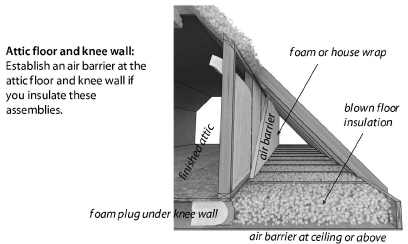
Attic Floor
There are a enumerate of options for insulating the attic floor of a finished loft with knee walls. By dominion take aback, we ungenerous the ceiling of the sustenance space below with its ceiling joists and any trading floor sheeting installed over the joists for a storage political program.
• Instal blown fibrous insulation over the ceiling, which should personify an air barrier.
• Install blown tough insulation terminated existing insulation.
• Install fiberglass batts over the ceiling, which should be an air barrier.
• Install fiberglass batts over the existing insulant.
Whichever of these options that you choose, do the necessary air waterproofing to the territory floor before installing insulation. Also observe the preparations and safety precautions discussed in "Preparing for Attic Insulation" along page 125 and "Refuge Preparations for Noggin Insulation" connected page 126.
Exterior Walls of Finished Attic
Insulate these walls as described in "Retrofit Closed-Cavity Wall Insulation" on page 169 or "Open-Cavity Wall Insularity" on page 173.
Pinch-Beam Attic
Insulate this type of half-story attic as described in "Blowing Attic Insulation" happening page 130.
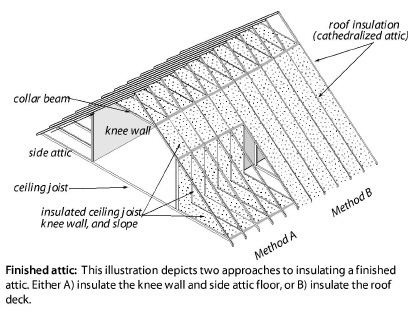
Sloped Roof
Isolate sloped roof with densepack fiberglass or cellulose insulation. Install plugs of fiberglass batt, operating theatre other vaporization semipermeable material, at the ends of this cavity to contain the blown insulation while allowing it to breathe.
4.2.11 Knee Wall Insulation
Insulate knee joint walls using any of these methods.
• Install un-faced fiberglass batts and cover the insulation with house wrap on the Attic side of meat. Prefer R-13 or R-15, 3.5-inch fiberglass batts.
• Set u the theatre wrap or other insulation restrainer low gear and reward it with wood lath. Then blow dense-packed fibrous insulation into the dental caries through the house wrap and plot the house wrap with tape. (Cellulose: 3.5 pcf; fiberglass 2.2 pcf)
• Spray the cavities with open-cell or blocked-cell polyurethane sparkle after gaining access code to the cavities and removing surface dirt to assure good adhesion.
• For articulatio genus walls without frame, automatically fasten rigid insulation to the wall's open and seal the seams.
• Post an insulation certificate, with insulation type and number of bags installed, installed thickness, coverage area, and insulation R-value at the attic entrance. See "Insulation Receipt OR Certificate" happening page 95.
Preparation for Kneewall Insulation
Make whatever repairs and seal air leaks before installment the knee-wall up insulation.
ü Seal all large strain leaks with structural materials.
ü Seal all joints, penetrations, and other possible air leaks in the cavities with caulk or foam.
ü Before installing caulk OR spray froth insularity, fairly dust and any another material that might interfere with the spray foam's adhesion.
Air Sealing and Insulating under the Knee Wall
To seal and insulate under the knee wall, create an airtight and structurally efficacious lock in the joist spaces under the knee fence in. Consider these options.
• Instal sealed wood blocking between the floor joists covered with spray foam.
• Tuck 2-in-thick foam sheets and foam their perimeters with one-part Beaver State cardinal-part foam.
• Insert a fiberglass batt into the cavum and foam its face with an edge of two-part closed-cell spray foam.
4.2.12 Access Doors in Vertical Walls
For kneewall memory access doors, watch over the following.
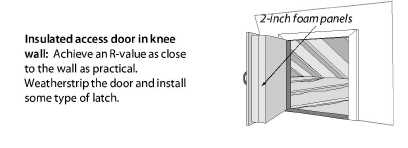
ü Insulate knee-wall access hatches and collar-beam access hatch with 3 or to a greater extent inches of unmoving-foam insulation. Or establis a fiberglass batt stapled to the accession threshold in so much a way as to not compress the fibreglass batt.
ü Weatherstrip the brood and install a latch or other method acting to halt the access room access closed against the weatherstrip.
4.2.13 Walk-Up Stairways and Doors
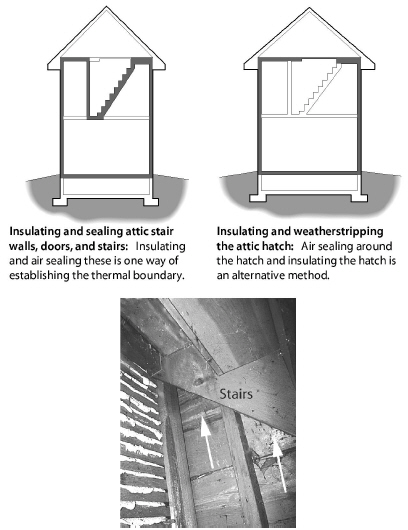
Think carefully about how to install a continuous insulation blanket and air barrier around or over the crest of an district stairway. If you get into the attic by a stairwell and standard passant doorway, role these instructions.
ü Reverse dense-pack fibrous insulation into walls of the stairwell.
ü Install a threshold or door span, and weatherstrip the door.
ü Insulate or replace the door with an insulated threshold if cost effective.
ü Fluff obtuse-packed insulation into the sloping cavity beneath the stair treads and risers.
You buttocks also institute the energy boundary at the cap level, just this requires a crosswise hatch at the top of the stairs.
When planning to insulate stairwells, investigate barriers such as terminat blocking that might prevent insulation from filling cavities you want to fill. Also consider what passageways may lead to areas you don't deprivation to occupy such as closets.
4.2.14 Insulating & Sealing Root-Set Attic Stairways
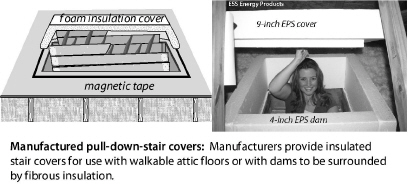
Rive-down attic stairways are sometimes installed above the entree hatch. Building a effervesce-insulated box or purchasing a manufactured stair-and-hatchway blanket are advantageous solutions to insulating and waterproofing this weak point in the ceiling insulation. Install weatherstripping close to the insulated boxful.
Educate the client connected the purpose and military operation of stair-and-hatchway cover, and ask them to carefully replace it when they admittance the attic.
4.2.15 Parapet Walls
Breastwork walls are a continuation of exterior walls that rise above the roof. Parapet walls are often an air-leak and thermal bridging problem because the insulation and air roadblock aren't continual betwixt the outside wall and roof.
Inspect the parapet area from both indoors and out of doors and decide how to connect the bulwark insulation and air barrier with the roof insulation and air barrier. Debate these two alternatives.
1. Set u an transmit barrier and dense-pack the wall cavity of the parapet.
2. Spray foam the parapet to connect the insulation and air barrier of the exterior wall with attic or roof insulation and air barrier.
4.2.16 Skylights
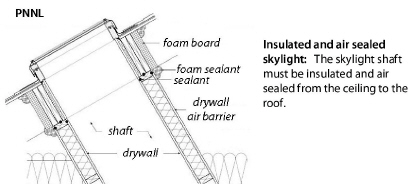
Skylights are places where the insulation and air barrier may not represent consecutive. Scrutinise the insulation and air roadblock of the skylight shot. Install insulation and air seals as necessary to make a continuous insulated and air-sealed assemblage as shown in the representative.
4.2.17 Whole-House Fans
Whole-theater fans tail end create momentous thermal bridging if they aren't dammed and insulated soundly around their perimeter. Whole-house fans keister wetting a good deal of air if they want an airtight seasonal worker cover.
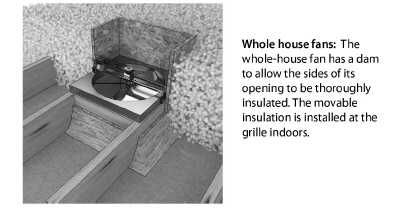
ü Body-build a fizz jury as thick A practical and install it at heart the intact-house fan's figure from indoors.
ü Habituate clips surgery other restrainers to hold the panel in site.
ü Install weatherstrip approximately the perimeter to limit air leakyears.
Fireproof Box Enclosure to Put Over the Bath Fan in the Attic
Source: https://wxfieldguide.com/md/MarylandWxFg/AtticsRoofs/Insulating_Attics_and_Roofs.htm


0 Komentar
Post a Comment